Hagar — The God Who Sees Me

In the modern times we live in today, women have many options to feel fulfilled in life, such as studying, having good job positions, being entrepreneurs, traveling, enjoying sports, hobbies, and entertainment, achieving other dreams, getting married, and having children.
For the women of the Bible, especially 3,000 or 2,000 years ago, becoming a wife and a mother was everything. Being the mother of the son of the man who had chosen her, so that his generations would continue carrying on his name, was like a mission and one of the greatest joys of her life.
But if a wife could not get pregnant, it was a custom in those times for her to have children through a servant or another woman, so that the child who was born could become part of her household and continue her husband’s family line. Socially, this was not condemned or classified as adultery, but was seen as a solution to enlarge the family and secure the next generation.
Not so different from nowadays… maybe a woman can try to become pregnant in a more technical way through in vitro fertilization, or a couple may agree to look for a surrogate mother to have their child.
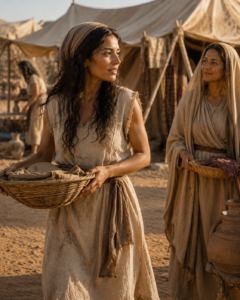
The Bible identifies Hagar as the young Egyptian woman who was Sarai’s servant. According to Jewish rabbinic tradition, Hagar had sexual relations with Abram only once, and from that union she became pregnant with Abram’s first son, Ishmael. After that, she was still Sarai’s servant, which surely must have been a disappointment for her.
Hagar had already lived with Abram and Sarai for ten years, and there is no record that Abram had ever shown a personal interest in her before. Sarai wanted so much to believe that God was going to give them a son, but the waiting had become long…
Thinking of Hagar as the right woman through whom Abram would finally become the father of the child who was to continue the promise of the great nation God wanted to make of him says a lot about how Sarai may have looked at Hagar. Sarai made no difference about whether she was Hebrew or not, or whether she was a dark- or light-skinned Egyptian woman. She simply saw Hagar as a nice, strong, healthy, hardworking, and very sweet and faithful servant who could bring into the world the most beautiful and noble baby—exactly like her.
Like any other young woman of her age, Hagar may have dreamed of one day falling in love, getting married, and having children. But perhaps that dream was cut short too soon by what happened in Pharaoh’s palace. After Pharaoh and his household were afflicted because of Sarai, Pharaoh ordered Abram and Sarai to leave Egypt with everything they had. Hagar, who was an Egyptian servant in Sarai’s household, went with them.
During all those years, surely Hagar had learned, especially through Sarai, about the God of the Hebrews. Growing up surrounded by many gods in Egypt, the transition to believing in one true God was probably slow, but it seems that something had begun to happen in her heart.
Hagar Runs Into the Desert
As we know the story… why did Hagar run away into the desert?
Maybe she thought Abram was going to look for her or send someone after her, and then Sarai would have to apologize to her. We don’t need to be too smart to know that a woman, alone and pregnant, would not survive very long in the desert.
And that was the moment when the Angel of the Lord appeared, asking her where she had come from and where she was going. Hagar fearlessly answered that she was running away, but she did not explain why. The angel already knew. He sent her back and told her to return to Sarai and submit to her authority—almost as if the angel himself had underlined for her what we later read in Colossians 3:22:
“Slaves, obey your earthly masters in everything; and do it, not only when their eye is on you and to curry their favor, but with sincerity of heart and reverence for the Lord.”
A Mother Carrying Her Own Child
When Sarai gave Hagar to Abram, her intention was to build a family through her. In that ancient arrangement, Sarai expected to receive the child into her household and raise him as the son through whom Abram’s family line would continue.
But Hagar was the one carrying that baby inside her.
Perhaps, as the baby grew within her, something changed in Hagar’s heart. Maybe she began thinking, This is my child. Maybe she could no longer imagine simply handing over the role of mother to Sarai. The Bible does not tell us exactly what Hagar was thinking, but it is not difficult to imagine the emotions of a young pregnant woman whose body, future, and motherhood had been decided largely by other people.
And in the end, Hagar remained Ishmael’s mother and raised her son herself.
Ishmael — “God Hears”
Even though Hagar’s son was not the son God had promised to Abram and Sarai, to God he was still Abram’s son. Therefore, God also placed a promise of many descendants upon him. The angel not only confirmed that she would have a boy, but also revealed something about his future.
The perfect ultrasound is God’s revelation, and the perfect diagnosis is God’s purpose for the future of a baby. Ishmael means “God hears.” With that name, the angel was giving assurance to Hagar that God had heard not only her cries in the desert, but also the misery she had carried for a long time.
God knew that, without a choice, she had left her land, her family, and her friends—and maybe even someone she had once loved. He knew she was powerless to decide the direction of her own life. Her dreams and hopes may have disappeared when she became a servant in Sarai’s household.
And while she was still young, she was required to have sexual relations with an 86-year-old man whom she had never loved in that way, and who apparently did not love her in that way either. God was not ignoring the fact that Hagar had become caught in circumstances created by Pharaoh’s decision and Sarai’s desperate attempt to make God’s promise happen in her own way. So the angel assured Hagar that her son also had a future. God promised that Ishmael’s descendants would become too numerous to count.
As a mother, I can imagine the relief she must have felt, at least knowing that the God of Israel remembered her son.
Hagar Meets the God Who Sees Her
And then Hagar did something extraordinary. She gave a name to the God who had found her:
“You are the God who sees me.”
As happened to Hagar, we better believe that in the loneliest and most bitter moments of our lives, God will never overlook the pain and the tears of our hearts. Hagar’s story reminds us that He is still the God who sees us. That was exactly what the presence and the words of the Angel of the Lord proved!
Thank You, Lord, for always caring!