

 Some women are born into a life that seems to have a clear direction. Others suddenly find themselves standing in a place they never planned to be, wondering how in the world they got there. Esther was one of those women. Her story begins not in a peaceful little village, but in the middle of the enormous Persian Empire, under the rule of King Xerxes. Esther was a young Jewish woman living far from the land of her ancestors, in Susa, the royal city. She had lost both her father and her mother, and her older cousin Mordecai had taken her in and raised her as his own daughter. We do not know how old Esther was when her parents died, or how much she remembered about them, but losing both parents while still young must have shaped her heart in ways we can only imagine. Mordecai became the father figure in her life, the one who protected her, taught her, advised her, and probably reminded her again and again that although they lived in Persia, they were still part of the people of Israel.
Esther probably grew up learning how to live between two worlds. Outside her home was Persia, with its language, customs, clothing, royal power, and many gods. Inside her home was her family’s cultural heritage and the God of Israel. Like many Jewish families living in exile, she may have learned early how to survive without drawing too much attention to herself. The Bible tells us that Esther was lovely in form and beautiful, and that when the king’s servants began gathering young women from all over the empire, Esther was also taken into the royal palace, of course, without her consent or Mordecai’s. As a normal young Jewish girl, she must have dreamed of marriage someday, maybe a home full of children, and a husband who knew her family. But suddenly those ordinary possibilities were taken out of her hands. She entered the palace because the king wanted a new queen.
That palace must have been overwhelming. Beautiful rooms, perfumes, servants, expensive fabrics, strange routines, rules for everything, and women from many provinces of the empire all being prepared for one purpose: to please the king. Esther was no longer simply Mordecai’s young cousin. She became one of many women being watched, trained, and prepared. The Bible says that Esther pleased Hegai, the man in charge of the women, and won his favor. He quickly provided her with beauty treatments, special food, seven servants, and the best place in the women’s quarters. There was something about Esther that people noticed, and I do not think it was only her beauty. She seems to have had a calm spirit, humility, and wisdom about how she carried herself.
Mordecai had told Esther not to reveal that she was Jewish. So, while she was learning how to live inside the Persian palace, she was also carrying a secret. Everyone saw a beautiful young woman from the empire, but inside she knew exactly who she was. It seems that at that time a background check or family origin was no more important than a beautiful appearance. Esther gave no reason for anyone to distrust her or suspect anything different. She just had to remember what not to say, what questions to avoid, and how to live in a place where no one knew the deepest part of her identity. Perhaps there were nights when Esther lay awake and wondered what her future would be. For sure, she missed Mordecai. But even in that strange place, God was already placing people around her and opening doors that Esther could not yet understand.
When Esther’s turn came to go before the king, she did not demand extra jewels, clothing, or anything beyond what Hegai advised. That little detail says something beautiful about her character. She did not seem desperate to outshine everyone else. She listened. She trusted the wisdom of someone who understood the palace better than she did. And when Esther went before King Xerxes, the king was attracted to her more than to any of the other women. He placed the royal crown on her head and made her queen.
Can you imagine that moment? The Jewish orphan girl who had entered the palace among many other young women did not return to the women’s quarters, because now she was the one wearing the crown of Persia. There were celebrations, servants, music, food, and people bowing before her. But underneath that crown, she was still Esther. The young woman raised by Mordecai. The girl who had lost her parents. The woman carrying a secret identity that even her husband did not know.
Everything was sounding amazing, but… being queen did not mean Esther suddenly had complete freedom. This was not a modern marriage where she could walk into her husband’s office whenever she wanted and say, “We need to talk.” The king had enormous authority. Even the queen could not approach him without being summoned. Esther lived in luxury, yes, but luxury does not always equal freedom. She had servants, beautiful clothes, jewelry, and royal rooms, but she also lived inside a system where one wrong action could cost her everything.
Then we know the story… Haman, one of the king’s most powerful officials, became furious because Mordecai would not bow down to him. Haman’s anger became so great that he did not want only Mordecai punished. He wanted every Jewish person in the empire destroyed. A decree was issued in the king’s name, and suddenly the entire Jewish population was under a death sentence.
Mordecai learned what had happened, tore his clothes, put on sackcloth and ashes, and cried bitterly. When Esther heard that Mordecai was mourning, she became deeply distressed. At first, she sent clothes for him to wear. Perhaps she had not yet understood the seriousness of what had happened, or she simply had not found out yet. Maybe she thought… Mordecai, please get up. Please put on your clothes. Tell me what is wrong. But he refused the clothing and eventually sent her a copy of the decree.
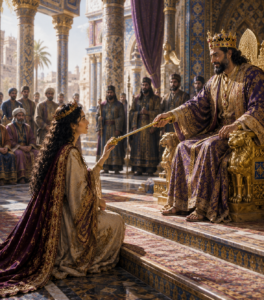
Then Mordecai asked Esther to go to the king and beg for mercy for her people. That must have been the moment when Esther’s crown suddenly felt very heavy. She knew the law. Anyone who went before the king without being summoned could be put to death unless the king extended his golden scepter. Esther told Mordecai that she had not been called to see the king for thirty days. Thirty days is a long time for a wife not to be called by her husband, especially when her life depends on his invitation. Perhaps Esther wondered if the king’s interest in her was fading. Maybe another woman had his attention. Maybe he was simply busy with royal affairs. Whatever the reason, Esther knew that walking into that throne room uninvited was not a small act of courage, but a very dangerous one.
Then Mordecai sent back the words that would change Esther’s life: “And who knows but that you have come to your royal position for such a time as this?” I can imagine Esther reading those words more than once. For such a time as this. I’m sure that everything began to look different before her.
The loss of her parents. Being raised by Mordecai. Being taken into the palace. Finding favor with Hegai. Becoming queen. Keeping her Jewish identity hidden. Could it be that all those pieces, including the ones that had made no sense at the time, had brought her to this exact moment?
Sometimes we ask God, Why am I here? Why did this happen? Why did You allow my life to take this direction? And we do not always receive an answer immediately. Esther probably did not understand the purpose of her position when the crown was placed on her head. But now she could see that perhaps she had not simply been placed in the palace to be honored and live comfortably. She was there because one day her people would need someone standing close enough to the king to speak.
Esther made her decision. She told Mordecai to gather all the Jews in Susa and fast for her for three days, without eating or drinking. She and her attendants would fast too. Then she said: “When this is done, I will go to the king, even though it is against the law. And if I perish, I perish.”
That sentence is not the voice of a woman who was not afraid. She was probably very afraid, but she had decided that fear was no longer going to make the decision for her. There is a big difference. Courage does not always mean that our hands stop shaking. Sometimes courage means that we move forward, trusting in God alone, while they are still shaking.
Then the third day came. Esther dressed in her royal robes. I imagine that moment must have been very quiet. Her attendants could help with the clothing, the hair, the jewelry, and the crown, but none of them could take the walk for her. Esther had to do that herself. She went and stood in the inner court of the palace, in front of the king’s hall. The king was sitting on his throne when he saw her. For one second, Esther probably could not know what he was thinking.
Had she broken the law? Would he become angry? Would the guards move toward her?
Then the king extended the golden scepter.
Esther was safe.
Can you imagine the breath she must have released? She approached and touched the tip of the scepter.
The king asked her what she wanted and told her that even up to half the kingdom could be given to her. But Esther did not immediately blurt out everything about Haman. She invited the king and Haman to a banquet. Then she invited them to another banquet. That was wisdom from Heaven; prayers were working… Esther knew when to speak, but she also knew when to wait.
At the second banquet, Esther finally told the king the truth. She revealed that she was Jewish. The secret she had carried since entering the palace was now placed right in front of the king. She told him that she and her people had been sold to destruction.
Imagine Haman’s face when he realized what had just happened. The woman sitting beside the king—the queen he had been proudly eating with—was one of the very people he had arranged to destroy.
The king became furious.
And suddenly the entire situation turned.
Haman, who had believed himself powerful and untouchable, was exposed. Esther, who had once seemed powerless inside a system controlled by men, became the woman whose courage helped save her people.
What an amazing turn!
But let’s remember something really important… Esther did not know that ending when she walked into the throne room. She just went in trusting the God of the Jews.
A Persian palace filled with wealth, politics, wine, servants, royal rules, and a pagan king probably did not look like the appropriate place for a Jewish woman. But God knew exactly where and when He wanted to put Esther to fulfill His divine purpose.
Esther’s story reminds us that we do not always know immediately why God allows us to stand in a particular place. Sometimes we understand only when the moment arrives.
You do not have to know the whole ending. You do not have to feel fearless. You only need to know that Esther’s God is the same God for us today, so be willing to take the next step He places in front of you.