

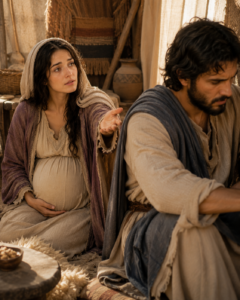
After Jacob finally found the town of Haran, the first person he met was Rachel, and he immediately fell in love with her. Rachel took him to her father, and when Laban heard that Jacob was the son of his sister Rebekah, he was very surprised and pleased. He welcomed him with great affection and shared a family meal in his honor, where Jacob was able to meet his relatives—and among them, of course, was Leah.
The Bible says: “Laban had two daughters; the name of the older was Leah, and the name of the younger was Rachel. Leah had weak eyes, but Rachel had a lovely figure and was beautiful.” The first time Leah enters the biblical scene of her own story, she is identified as almost the opposite of what her sister was—and both sisters knew it.
We know that at that time, and still today in some cultures of the Middle East, women did not always have an opinion or a decision about their own lives. Their parents or older brothers often decided for them. Laban knew that this had not been the case with his sister Rebekah, because their family had given Rebekah the opportunity to make the final decision about leaving with Abraham’s servant. But unfortunately, that was not the example Laban would follow with his own daughters, Leah and Rachel.
Yes, Laban wanted his daughters to marry, but he did not seem to care very much whether they were going to be happy or not. He had a “reputation” that he wanted to “maintain” in his community, and he did not want to tarnish it by having daughters without husbands or children. He probably was not too worried about Rachel because she was beautiful, but he knew Leah was going to have a harder time finding someone.
Laban appeared to be completely in agreement with Jacob’s proposal to work seven years for Rachel. Leah did not seem to have the same luck with men as her younger sister, so when Laban told Jacob that he would rather give Rachel to him than to another man, perhaps Laban was already thinking that he had a better plan. But it was God who had already laid out a plan for Jacob and for his descendants, who would become as numerous as the dust of the earth. God was the One who ultimately decided—not Laban.
During those seven years, Leah probably grew to like Jacob too, but perhaps more like a great brother-in-law. Sometimes Leah could probably see that her father was going a little too far in expecting so much work from Jacob. But Jacob himself did not seem to notice. As much as he may have enjoyed talking with Leah now and then, he was totally in love with Rachel, and because of her, he was willing to do it all. For Jacob, Leah was probably a very nice sister-in-law—perhaps like the sister he had never had.
Finally, the seven years came to an end. Jacob went to his uncle and future father-in-law and asked for his wife because he had fulfilled his part of the agreement. Laban had no objection to Jacob’s request and decided to celebrate the wedding. Now Leah and some of the servant girls could begin preparing for Rachel’s wedding. At that time in Haran, fancy invitations and extreme decorations were not important, but the food, music, and wine certainly were, as well as how beautiful the bride would look.
After many hours of celebration, Laban knew that his plan was going to hurt his daughters, but in the end, that seemed to matter very little to him. Perhaps he thought they would simply get over it soon. After so much partying, eating, and drinking, the long-awaited moment finally came for Jacob. “Where is my wife?” And Laban could say, “Here is my daughter. Take her and make her your wife, and may you both be happy!” Everyone applauded them. It probably looked like a very normal and happy moment.
But underneath those wedding veils was a frightened woman who had been forced to become the wife of a man who did not love her. And a little while earlier, somewhere in one of the back rooms of the house, Rachel may also have been forced to stay there and keep quiet.
The Bible does not say that Jacob was drunk, although wedding celebrations at that time normally included plenty of wine. In addition, Laban waited until evening to bring the bride to Jacob. The light from the small oil lamps inside the wedding tent was probably so weak that they could barely see where they were walking. Jacob was so happy that perhaps he did not notice that his normally talkative and bubbly bride seemed extremely calm and quiet.
Without a doubt, after finally being alone with the woman he believed was Rachel and expressing all the romantic passion he had been holding for seven years, Jacob eventually fell asleep. While Jacob believed that everything he had done had been worth it because now he finally had the woman he loved in his arms, Leah’s heart must have been very different.
She was probably terrified. She knew that when Jacob discovered the deception, there was going to be a terrible problem—not only with him, but also with her poor sister Rachel, who must have been devastated. But how could Leah fix any of this when she did not even have the right to say anything? She was simply another victim of her father’s manipulative plan.
In the morning, when Jacob woke up, perhaps for one peaceful moment he felt satisfied knowing that he was finally no longer sleeping alone. Then, when he reached over to wake his beloved wife with a caress and a kiss, he realized: She was not Rachel.
In one second, so many things must have gone through his mind. This is my sister-in-law, Leah! Leah, what are you doing here? What have I done? How could I confuse you with Rachel? Did I really make love to you believing you were Rachel? What happened here?
And with a weak and nervous voice, perhaps Leah had only one answer: “My father did this.”
What else could she say? That poor girl had very little free will in the matter. She had been commanded to lie in Jacob’s bed, stay quiet, and obey. Jacob was so enraged that perhaps, for a moment, he looked at Leah with contempt. Leah must have felt ashamed and completely humiliated. But at the same time, she probably did not blame Jacob for his reaction. She understood that he had gone to sleep believing that he was finally with the woman he loved.
Jacob ran out of the wedding tent furious with his father-in-law, shouting at the top of his lungs that he had fulfilled their agreement. He had worked the seven years! So why had his father-in-law not honored their agreement? Why had his uncle done this to him? Why had he done this to Rachel?
Jacob loved Rachel. But Leah was now his wife, and what had happened between them could not simply be erased. Although he did not love Leah the way he loved Rachel, he did not hate her either. He was not going to abandon her, knowing that after everything that had happened, her chances of another marriage could be destroyed. None of this was Leah’s fault. Perhaps he even felt sorry for her. So Jacob did not publicly disgrace her or deny her place in his household. Leah remained known as Jacob’s first wife.
But Laban was not finished making unfair deals. After Jacob completed the first week of marriage with Leah, Laban allowed him to marry Rachel also—in exchange for another seven years of work. And Jacob accepted.
When that first week was over, Leah could probably see Jacob’s excitement. Finally, he was going to marry Rachel. That must have been extremely painful for Leah.
 God Saw Leah’s Wounded Heart
But even though this was a moment of great darkness for her, right in the middle of it all Leah was about to discover what we later read in Ephesians 3:18—how “wide and long and high and deep” God’s love was for her. His compassion and protection were already surrounding her. God became the loving Husband her wounded heart needed, the One who would hold her through the years ahead.
As He says in Isaiah 54:5: “For your Maker is your husband—the Lord Almighty is his name—the Holy One of Israel is your Redeemer; he is called the God of all the earth.”
And if you who are reading this see something of yourself in Leah, remember that the same Heavenly Husband she had—the Almighty, the Holy One of Israel, the One who sees everything and always has a special plan—is there for you too.
Jacob did not choose Leah, but God did. Six of the tribes of Israel came from her, including the tribe of Judah, through whose line the Messiah would come.
He also has a plan for your life; He will guide you; He will protect you; He will fight your battles, and He will win them for you!
I know that because Leah was there, and because I’ve been there too. I know His faithfulness is true and incomparable!
Blessed be His Name forever!