

Sometimes life changes so suddenly that we do not have time to prepare our hearts for what is coming. One day we are living the life we know, surrounded by family and friends, enjoying what is around us, and building our future. Then something happens that divides life into a “before” and an “after.” Ruth knew what that felt like.
She was a Moabite woman who had married into a Hebrew family that had come to live in Moab because of famine in Judah. Elimelek and his wife Naomi had left Bethlehem with their two sons, Mahlon and Kilion, probably hoping that Moab would only be a temporary place where they could survive until the famine passed. But sometimes a temporary place becomes many years, and life begins happening there whether we planned it or not.
Elimelek died, leaving Naomi alone with her two sons. Later, those sons married Moabite women, Orpah and Ruth. For Ruth, marrying Mahlon probably meant that she was not only joining herself to a husband, but also becoming part of a family whose customs, food, traditions, and faith were different from the ones she had known growing up.
She was a Moabite woman entering a Hebrew household. Perhaps at first she listened quietly when Naomi spoke about the God of Israel. Maybe she heard stories about Abraham, Isaac, Jacob, Egypt, Moses, and the land God had given to His people. We do not know exactly how much Ruth understood in those early years, but something about Naomi, her family, and especially her God must have begun making a deep impression on Ruth’s heart.
Then tragedy came again. Mahlon and Kilion also died. In just a few verses, the Bible tells us that Naomi was left without her husband and without her two sons. Now there were three widows sitting inside one house, each carrying her own grief. Naomi had lost her husband and both of her children. Ruth and Orpah had also lost their husbands.
There must have been many quiet evenings in that home when nobody knew what to say. Perhaps there were days when one woman cried and the others simply sat beside her. Maybe one of them tried to prepare food and suddenly lost the desire to eat. Grief does not always look dramatic. Sometimes it is simply an empty place at the table that keeps reminding you who is missing.
After some time, Naomi heard that the Lord had provided food again for His people in Judah. So she decided to return home to Bethlehem. She believed there was nothing left for her in Moab. Her husband was gone. Her sons were gone. She had no grandchildren to stay for. She was getting older, and the family she had built was no more…
Bethlehem had once been the place she left because there was no bread. Now she wanted to return because there was bread again.
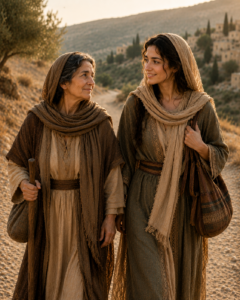
Ruth and Orpah began the journey with her. Maybe at first nobody talked much. They simply walked. Three widows moving down the road with their few belongings, leaving behind one life without knowing exactly what the next one would look like.
But somewhere along the way, Naomi stopped. She looked at these two young women and realized what they were giving up by following her.
So Naomi told them to return to their mothers’ homes and find new husbands. She blessed them and asked the Lord to show them kindness. In other words, Naomi was saying, “You are still young. You can start over. Do not throw away your future because of me.”
They hugged and cried together. It was not an easy goodbye. These women had shared a home, marriages, deaths, meals, memories, and grief. Naomi was not simply their mother-in-law anymore. They had become family.
At first both Ruth and Orpah said they would go with Naomi. But Naomi insisted. She had no more sons to give them. She had no wealth waiting for them in Bethlehem. She could not promise them husbands, children, comfort, or security.
In fact, from a practical point of view, following Naomi was not really a great idea, because the only thing they knew about that land was that they had once fled from it because of a terrible famine.
Orpah heard Naomi… so eventually she kissed her goodbye and returned to her people.
And we should not make Orpah into a bad woman because of that. She loved Naomi. She cried. She had already begun the journey. But in the end, she made the reasonable decision. She went back to the life she knew, with her family.
Ruth did something different. She did not simply stand beside Naomi. She clung to her.
Naomi encouraged Ruth to go with Orpah, but Ruth answered with some of the most beautiful words ever spoken by one woman to another:
“Where you go I will go, and where you stay I will stay. Your people will be my people and your God my God.”
Ruth was making more than a promise to Naomi; she was making a decision about her own life too. She was leaving Moab, her people, and the gods she had grown up with, most likely forever…
She was walking toward Judah, toward the people of Israel, and toward the God of Naomi. She had no guarantee of what would happen to her when she arrived in a nation that for many years had been in conflict with her own. Besides, what exactly was there waiting for Naomi? She did not have a husband waiting. She was not even sure if their house was still there. No job had been arranged for Ruth to do.
And how about the neighbors…? Would they welcome her?
Ruth simply took the next step in a faith she was not yet understanding very deeply. Sometimes faith can look like a woman walking down a dusty road beside her mother-in-law because she has decided that the God of Israel will now be her God too.
When Ruth and Naomi finally arrived in Bethlehem, the whole town was stirred because of Naomi. The women asked, “Can this be Naomi?” Naomi answered bitterly and told them to call her Mara because the Almighty had made her life very bitter. She said that she had gone away full and returned empty.
While Naomi was saying that she had come back empty, Ruth was standing right beside her… maybe thinking for a moment, Why would the God of Israel do something like that to one of His children?
Well… sometimes pain becomes so large that we cannot yet see the blessing standing only a few feet away.
Ruth was a faithful young woman who had left everything to stay with her mother-in-law. And God was going to use that relationship in ways neither woman could yet imagine.
They arrived in Bethlehem at the beginning of the barley harvest, and that was important because Ruth and Naomi needed food. They were two widows with no man in the household to provide for them. Under the law God had given to Israel, landowners were not supposed to harvest every last piece of grain from their fields. They had to leave some behind for the poor, the widow, the foreigner, and the needy to gather.
Ruth was all of those things together: poor, a widow, a foreigner, and in need. Naomi probably explained all that to Ruth so she would know it was okay if she wanted to go to the fields and gather leftover grain behind anyone who would show her favor.
I can imagine Naomi watching Ruth leave that morning, content, without complaining, and promising her that she would bring food home that night.
Ruth probably looked and dressed differently from the other women of Bethlehem. Perhaps her accent was different. People knew she was the Moabite woman who had come back with Naomi. She was the outsider.
But Ruth did not sit at home waiting for life somehow to improve… She went to work.
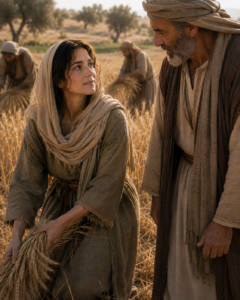
That first day, Ruth happened to enter a field belonging to a man named Boaz. Ruth did not wake up that morning knowing she was walking into the field of the man who would change her future. She woke up hoping that the God of Israel would somehow guide her to find food.
But God already knew whose field He wanted to send her to.
So Boaz arrived and noticed Ruth. He asked his overseer, “Who does that young woman belong to?”
The overseer explained that she was the Moabite woman who had returned with Naomi and that she had been working steadily from morning until then.
Boaz had already heard about her. He knew how Ruth had cared for Naomi after her husband died. He knew that she had left her father, her mother, and her homeland to live among a people she had not known before.
Ruth probably thought she was invisible in that field. Just another poor woman picking up leftover barley.
But someone had noticed her faithfulness. And much more importantly, God had noticed it.
Boaz told Ruth to stay in his fields and not go somewhere else. He instructed his workers not to bother her. He gave her permission to drink from the water his men had drawn.
Later, he even told his workers to deliberately pull out some stalks from the bundles and leave them for her.
Ruth was speechless. She bowed down and asked why she had found such favor when she was a foreigner.
Boaz told her that he had heard everything she had done for Naomi. Then he said something beautiful:
“May you be richly rewarded by the Lord, the God of Israel, under whose wings you have come to take refuge.”
Ruth had left Moab without knowing what would happen. Now, in the middle of a barley field, someone was reminding her that she had taken refuge under the wings of the God of Israel.
Maybe she, and all the workers around her, needed to hear that.
Maybe all of us do too sometimes.
Has it ever happened to you that when we decide to trust God, a few days later we wonder whether we made a terrible mistake?
That can be almost normal, because faith does not remove uncertainty immediately.
Ruth still had no husband. She still had no permanent home of her own. She was still a widow and a foreigner.
But now there was food. There was protection. There was kindness. There was Boaz.
At mealtime, Boaz invited Ruth to sit with his workers and eat. He gave her roasted grain, and she ate all she wanted and even had some left over, which she took home to Naomi.
That is such a small detail, but it tells us so much about Ruth.
Even while she was hungry herself, she remembered the woman waiting for her at home.
At the end of the day, Ruth carried home a large amount of barley. Naomi must have looked at that grain and thought, Where in the world did you work today?
When Ruth told her that the man’s name was Boaz, something changed in Naomi.
She knew exactly who he was. Boaz was one of their family’s close relatives, one of the men who could act as a kinsman-redeemer.
Suddenly the woman who had said, “Call me Mara,” began to see a little light.
For sure, God had not forgotten them after all.
Ruth continued working in Boaz’s fields through the barley and wheat harvests. During that time, Naomi began thinking like a mother again.
She wanted Ruth to have a home and a future.
Eventually Naomi told Ruth what to do. She instructed her to wash, put on perfume, dress nicely, and go to the threshing floor where Boaz would be.
Now, if we are sitting together with tea and banana bread, this is the part where we probably look at each other and say, “Naomi… what exactly are you planning?” 
But Ruth trusted her mother-in-law, or actually, her new real mother.
She went to the threshing floor and waited until Boaz had eaten, drunk, and settled down to sleep near the grain.
Then she quietly approached, uncovered his feet, and lay down next to him.
In the middle of the night, Boaz woke up startled and discovered a woman lying at his feet.
“Who are you?” he asked.
“I am your servant Ruth,” she replied, and she asked him to spread the corner of his garment over her because he was a guardian-redeemer of their family.
This was not Ruth trying to seduce Boaz into some cheap romantic scene.
She was asking him for protection, covenant, family, and marriage.
And Boaz understood exactly what she meant.
He blessed her and praised her kindness. He knew Ruth could have pursued younger men, rich or poor, but she had chosen to honor the family responsibility connected with Naomi.
Boaz also told her there was another man who was actually a closer relative and had the first right of redemption.
Again, Ruth had to wait.
How many times in this story did she have to move forward without knowing the ending?
She left Moab without knowing. She entered a field without knowing. She followed Naomi’s instructions without knowing.
And now she had to return home without knowing… while two men settled her future at the town gate.
So, very early in the morning, before Ruth left the threshing floor, Boaz filled her shawl with barley to take home.
When Ruth returned, Naomi asked her how things had gone.
After Ruth explained everything, Naomi told her:
“Wait, my daughter, until you find out what happens. For the man will not rest until the matter is settled today.”
Wow… what words of wisdom and trust in God.
So Boaz went to the town gate and handled the matter publicly and honorably.
The nearer relative declined the responsibility, and Boaz became Ruth’s redeemer and married her.
Amazing…!
The woman who had left Moab as a childless widow was now the wife of a respected man in Bethlehem.
The foreign woman became part of the people of Israel.
And in time, Ruth became pregnant and gave birth to a son.
The women of Bethlehem celebrated with Naomi and said that the Lord had not left her without a guardian-redeemer. They said Ruth, her daughter-in-law who loved her, was better to her than seven sons.
Can you imagine Naomi holding that baby?
The woman who once said she had returned empty now had a grandson in her arms.
The baby was named Obed. Obed became the father of Jesse. Jesse became the father of David.
And many generations later, from that same family line came Yeshua.
Ruth could not have seen any of that when she was walking away from Moab.
She did not know that one dusty step of faith, choosing Naomi, her people, and her God, would eventually place her name in the genealogy of the Messiah.
Ruth only knew that she came to Bethlehem because she loved Naomi. And because of that, she chose Naomi’s people and Naomi’s God.
What a great testimony of faith Naomi had been for Ruth.
The beauty of her whole story is that Ruth did not know what was waiting for her in Bethlehem.
But God did!